
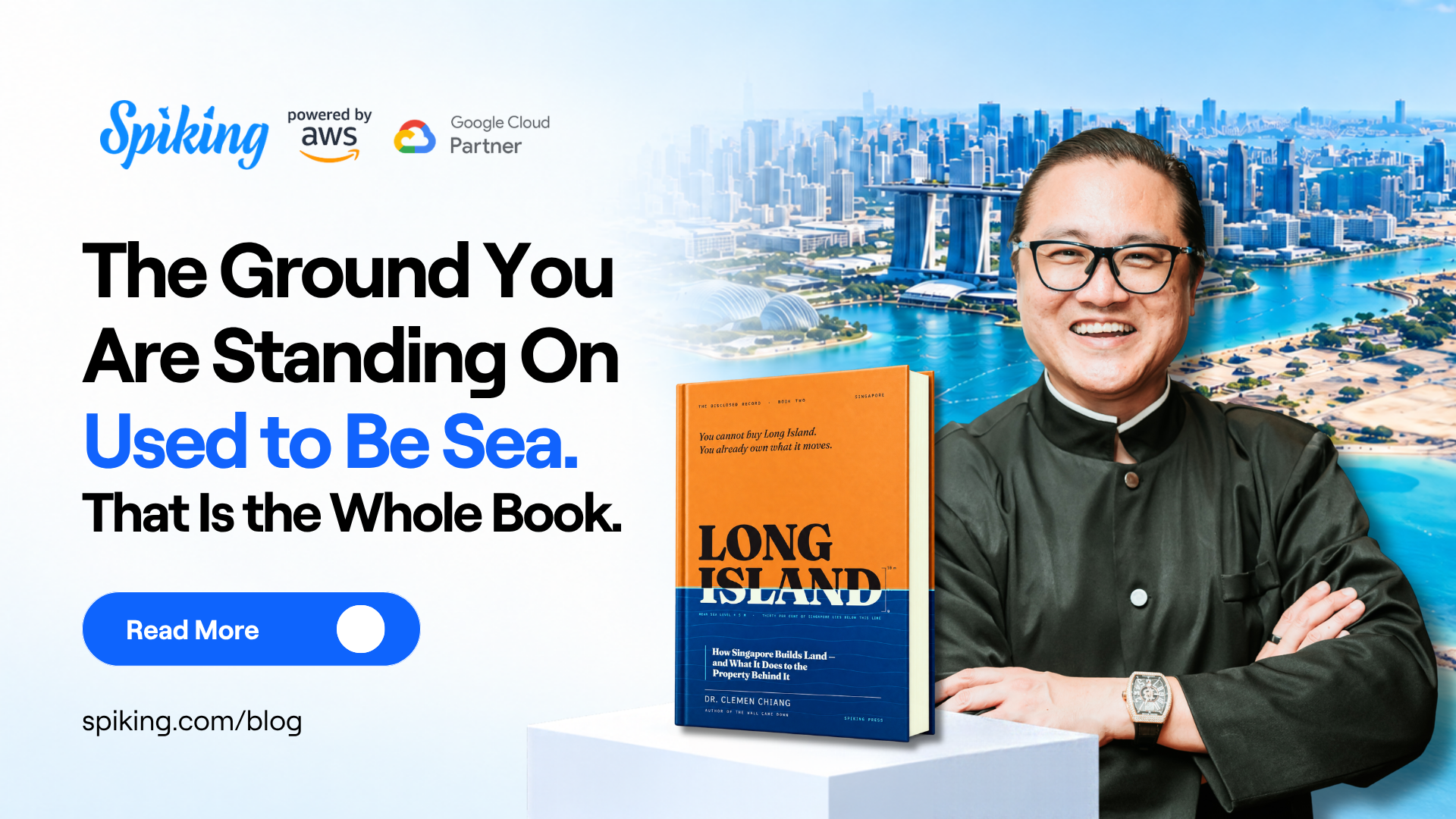
The Ground You Are Standing On Used to Be Sea. That Is the Whole Book.
Discover how Singapore’s Long Island project could reshape the East Coast, coastal planning and the way property is understood.

Table of Contents
Walk east along the promenade from Tanjong Rhu on a Sunday morning.
You will see past cyclists, barbecue pits, families out for a walk, and the familiar queue outside the food centre. But here is something easy to forget: almost nothing you can see seaward of Mountbatten Road existed in 1965.
The blocks at Marine Terrace, the schools, the wet market and even the beach you are walking towards were created. They were built deliberately and at enormous scale, using earth from hills that were cut down and sand that was brought in.
Singapore has done this before, and successfully. People now live, work and raise families on land that once did not exist. And now, Singapore is proposing to do it again.
The project is called Long Island. It involves about 800 hectares off the East Coast, planned across three tracts, together with Singapore’s 18th reservoir and around 20 kilometres of new coastline.
Today, Dr. Clemen Chiang’s second book is out: Long Island: How Singapore Builds Land — and What It Does to the Property Behind It.
What Is Inside the Book
Almost everything written about Long Island comes from a relatively short media release. This book goes deeper. It draws from the documents behind the project, including a 557-page environmental study, a statute passed this year, a code of practice, the Master Plan, Hansard, and even a planning timetable from 1991. That 1991 record matters because it shows how far back the Long Island idea goes. At the time, the concept appeared as a resort island designed for around 65,000 people.
The book sets out the record carefully, document by document and date by date.
Who said what? Which document did it appear in? When was it published? What has actually been announced? What has been formally approved? And what has genuinely been built?
These are three different things that are routinely written as one. Chapter 22 gathers together something that is often missing from discussions about Long Island: everything that has not yet been decided. That includes the individual land parcels, tenure, housing mix and development timetable.
There is still much we do not know, and the book makes that clear rather than filling the gaps with assumptions.
What You Will Not Find in the Book
There is no forecast of what Long Island will eventually be worth. Nobody knows, and the agencies responsible for building and planning it make that clear in their own publications. No rates, thresholds or prices either, because they change; instead, the book shows readers where the relevant figures are officially published and how to retrieve them when they actually matter.
There is also no praise section. In fact, the praise page says exactly that. Rather than asking readers to simply trust what is written, the book asks to be checked. Every major claim about Long Island is traced back to a dated document in Appendix A, one line at a time.
Where Dr. Clemen Chiang was wrong — six times — the correction appears on the same page where the mistake was made, together with the name of the reader who identified it. That is one of the rules behind the series this book belongs to: The Disclosed Record. For Dr. Clemen Chiang, being corrected in public matters more than being trusted in private.
Why Long Island Matters Even If the Project Never Happens
Long Island may be the title of the book, but almost half of it is not really about Long Island at all. It is about learning how to read any property address in Singapore more carefully.
The book walks through the Master Plan as it is actually published, the lease clock, elevation bands, and the line that the coastal code may now draw on a property title. It also examines what happens when a new waterfront is created and how that may affect the land sitting behind it. Then it moves into the property purchase itself.
What is the sequence? At what point does the money stop being yours? What can be borrowed? And why should Singapore property be understood through four different doors — four different instruments — rather than simply four different prices?
That method remains useful regardless of what ultimately happens to Long Island. The reclamation could be delayed by ten years. It could be redesigned, or quietly dropped, the framework would still work on the property you are sitting in today. That is the larger point.
One Number Worth Remembering
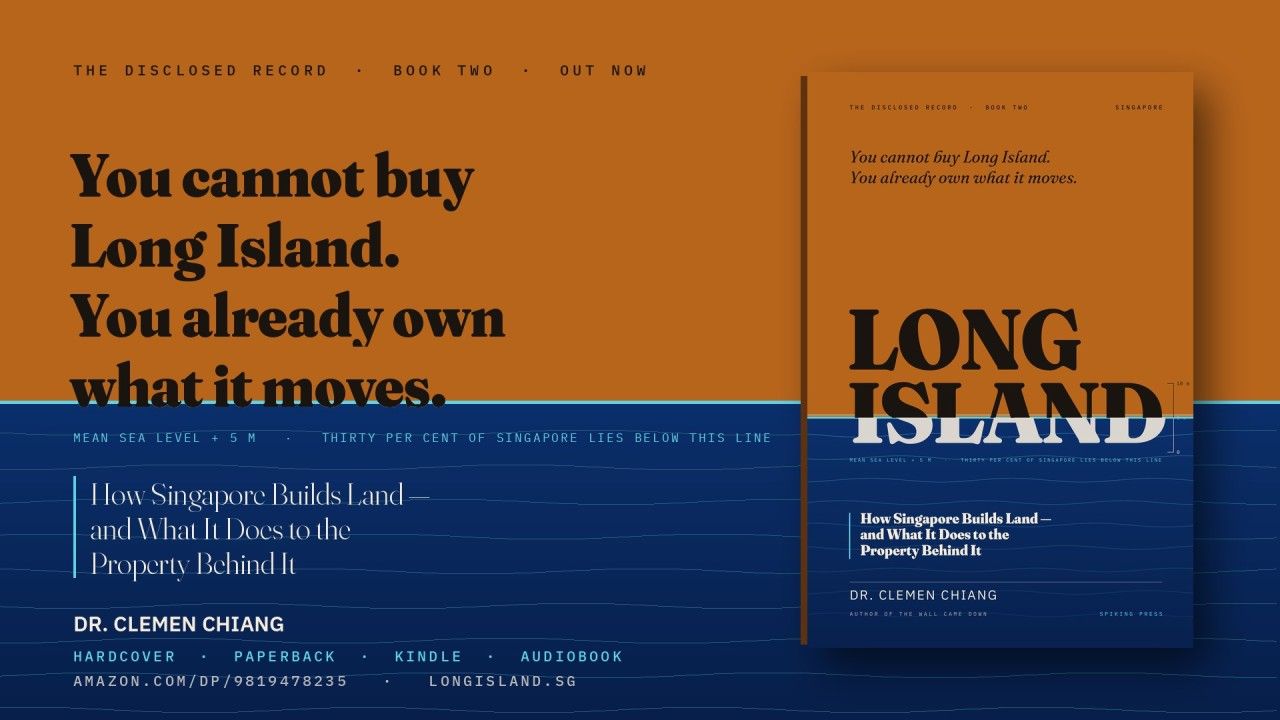
If there is one figure to carry with you from the book, it is this: Mean sea level plus five metres.
Around 30% of Singapore lies below that line. It is the only figure placed on the cover of the book. The book explains why it may be one of the most important numbers for a property buyer to understand when thinking about Singapore’s coastline, elevation and long-term planning.
It also explains why adding a decimal point would create a level of precision that simply does not exist.
The Record Does Not End With the Book
A printed book is ultimately a snapshot. Government plans change. New studies are released. Documents are updated. That is why the maintained record continues at longisland.sg.
The website contains the document register, kept current and dated, together with an atlas of the coastline. When the Ministry publishes something new, the register can be updated. And when Dr. Clemen Chiang identifies an error, the correction appears there first.
The aim is not to create a book that becomes frozen in time. It is to maintain a record that can continue to be checked.
Long Island Is Part of a Bigger Series
Long Island: How Singapore Builds Land — and What It Does to the Property Behind It, is available on Amazon in hardcover, paperback and Kindle, as well as in audiobook format.
It is Book Two of The Disclosed Record series.
Book One, The Wall Came Down, examines options.
Book Three, Nine Pages, focuses on Bitcoin.
Three assets. One method.
Long Island’s proposed 800 hectares gave us a reason to look more carefully.
— Dr. Clemen Chiang
Long Island — How Singapore Builds Land, and What It Does to the Property Behind It.
Spiking Press, 2026. longisland.sg


