The basics
What is a protective put?
You hold the shares and you buy one put. The put is the right to sell those shares at the strike. You pay a premium for that right.
A long put alone is a view that the price falls. A protective put uses the same contract as a floor under a holding you mean to keep.
The floor is dated. When the put expires, the protection expires with it, unless you buy it again.
Insurance on a holding. The $97 is the cost of a floor at 95. It is not a promise that the shares rise.
The price at which the floor begins. Falls below 95 are offset by the put.
The date the floor ends. Keeping the protection means buying a new put.
What the floor costs, per share. It raises the breakeven on the shares from 100 to 100.97.
Payoff diagram
See the profit and loss at expiry
Under the strike the picture is flat. That is the floor. Above the breakeven the line rises with the shares. Drag the slider to try a price.
At 100.00 the put is still out of the money. You are down the unused premium, and any dip in the shares. The result is −0.97 per share.
Expiry payoff only. Before expiry the option also carries time value, so profit or loss on an earlier day differs from this line.
The three numbers
Protective put floor, breakeven and the rise you still keep
You can work out all three before you place the order.
share price + premium100 + 0.97. The shares have to rise by the cost of the put before the pair is ahead.
(share price − strike) + premium100 − 95 + 0.97. It is reached at the strike and does not grow below that.
the shares, minus the premiumAbove the breakeven, each 1 point rise in the stock adds 1 point per share.
(stock − 100) − premium + max(strike − stock, 0)Below the strike, the last term adds back every extra point. The result stays at −5.97.
Where the stock finishes at expiry
The shares are down 20. The put is worth 15. After the 0.97 premium, the loss stops at 5.97 per share.
The put expires unused. The shares are up 10, minus the 0.97 premium. The profit is 9.03 per share.
Shares marked at 100. 30-day 95 put bought for 0.97. Gross of commissions.
Quick check
Shares bought at 100, a 95 put bought for 0.97, and the stock finishes at 80. What is the loss on the pair?
Inside the free masterclass
What the 45 minutes cover
Plain definitions and live payoff charts, with no tips or price targets. It starts at the contract, so no experience is needed.
when the session begins
Reserve your seat
One free live session on Zoom with Dr. Clemen Chiang. You sign up on the masterclass page.
- Date
- Tuesday, 12 January 2027
- Singapore time
- 8:00–8:45 PM SGT
- Your local time
- Tuesday, 12 January 2027, 8:00–8:45 PM SGT
What an option actually is
Right versus obligation, strike, expiry and premium, with the contract in front of you.
Stock versus option, side by side
The same market view expressed two ways: where leverage comes from, what it costs and what quietly expires.
Reading a payoff
How to find maximum loss, breakeven and the zone where a strategy works.
Two-sided structures, built live
Straddle and strangle: why they profit on movement, what they cost and when they fail.
Where the 56 strategies fit
A map of ten families, from single-leg directional structures to synthetics.
Then a short look at where options sit in a wider portfolio, and a live question segment. General education only.
 Live · camera on · charts live
Presented live by
Dr. Clemen Chiang
Founder and CEO of Spiking, the Singapore-based platform that tracks institutional money flows and options activity. He teaches the session himself, with the camera on, the charts live and no pre-recorded segment.
His work on options began with correspondence with an instructor at the CBOE Options Institute in 2000, leading to the Options Trading Championship held in Singapore in 2006.
- Role
- Founder & CEO, Spiking
- Format
- Plain English · live charts · general education
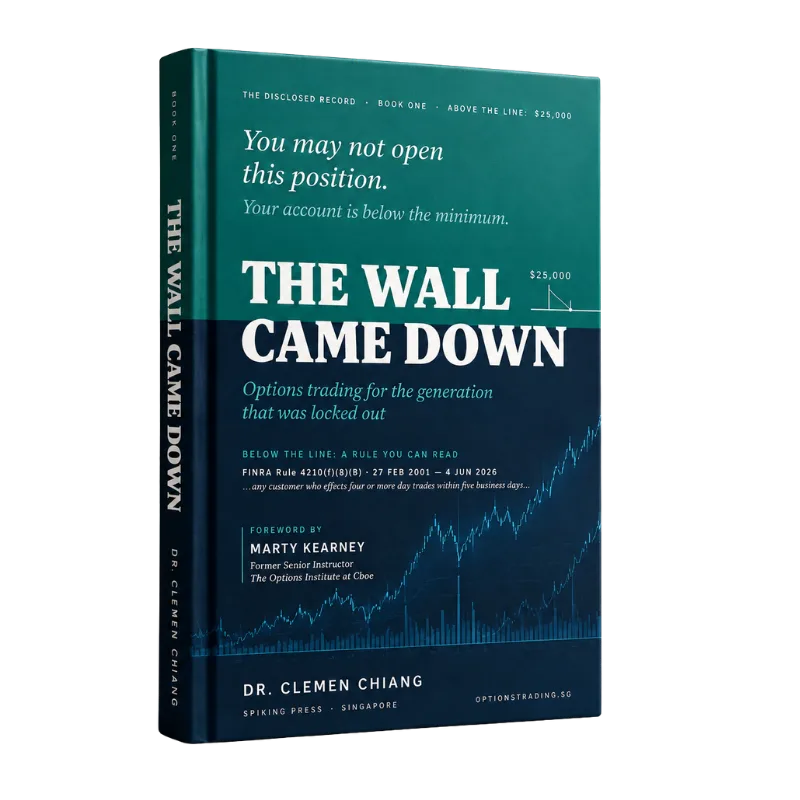
New book · Dr. Clemen Chiang
The Wall Came Down
Options Trading for the Generation That Was Locked Out
Every one of the 56 structures, written out with its payoff, breakeven and the conditions in which it fails, against one transparent option chain you can check yourself.
Hardcover · Paperback · Kindle · Audiobook · ISBN 978-981-94-7240-6
The masterclass is the 45-minute live introduction. The book is the reference you keep.
Straight answers
Protective Put FAQ
What is a protective put?
Long shares and a long put on those shares. The put is a floor. You pay a premium for it. Married put is another name for the same pair.
How do you calculate the breakeven?
Add the put premium to the price you paid for the shares. Shares at 100 and a premium of 0.97 break even at 100.97.
What is the maximum loss?
The distance from the share price down to the strike, plus the premium. Here that is 5 + 0.97 = 5.97 per share, once the stock is at or below 95.
Does the floor last?
Only until the put expires. After that the shares are unprotected unless you buy a new put.
Is the premium wasted if the shares rise?
It is the cost of a floor you did not have to use. The page treats that as insurance that expired, and the breakeven is higher by that cost.
How is this different from a long put?
A long put is the contract on its own. A protective put is that contract bought against shares you already hold.
That was strategy 8 of 56.
The free masterclass shows how the other strategies fit around it. In 45 minutes, Dr. Clemen Chiang goes from the contract itself to reading payoffs and building structures live. No experience needed.
- Tuesday, 12 January 2027
- 8:00–8:45 PM SGT
- Live with Dr. Clemen Chiang
Free to join. You sign up on the masterclass page.