The basics
What is a long call?
A long call is the simplest bullish options trade. You buy one call option and hold it. The call gives you the right to buy the underlying shares at a set price, up to a set date.
You pay for that right at the start. That payment is the most you can lose.
Most traders who buy calls never take the shares. They sell the contract before expiry or let it lapse. A call is a way to hold a view on direction at a fixed, known cost.
A right, not an obligation. If it goes wrong, the $108 is the most you can lose.
The price at which you may buy the shares.
The date the right ends. After it, the call is worth nothing.
What you pay, quoted per share. A standard contract covers 100 shares, so you pay $108.
Payoff diagram
See the profit and loss at expiry
The flat section is the premium you can lose. Past the breakeven, profit rises one for one with the stock. Drag the slider to try a price.
At 110 the call is worth 5.00 at expiry. You paid 1.08, so the profit is 3.92 per share.
Expiry payoff only. Before expiry the call also carries time value, so profit or loss on an earlier day differs from this line.
The three numbers
Long call breakeven, max loss and max profit
You can work out all three before you place the order.
strike + premium105 + 1.08. The stock must finish above this price for the trade to make money.
premium paid$108 per contract. It happens at any expiry price of 105 or lower.
no capAbove the breakeven, each 1 point the stock rises adds 1 point per share.
max(stock − strike, 0) − premiumIf the stock is below the strike, the first term is zero and you lose the premium.
Where the stock finishes at expiry
The call is worth 5.00. Minus the 1.08 you paid, the profit is 3.92 per share, or $392 per contract.
The call expires worthless. You lose the premium: 1.08 per share, or $108 per contract.
30-day 105 call bought for 1.08. Gross of commissions.
Quick check
The 105 call costs 1.08 and the stock is at 100. How much of that premium is intrinsic value?
Inside the free masterclass
What the 45 minutes cover
Plain definitions and live payoff charts, with no tips or price targets. It starts at the contract, so no experience is needed.
when the session begins
Reserve your seat
One free live session on Zoom with Dr. Clemen Chiang. You sign up on the masterclass page.
- Date
- Tuesday, 12 January 2027
- Singapore time
- 8:00–8:45 PM SGT
- Your local time
- Tuesday, 12 January 2027, 8:00–8:45 PM SGT
What an option actually is
Right versus obligation, strike, expiry and premium, with the contract in front of you.
Stock versus option, side by side
The same market view expressed two ways: where leverage comes from, what it costs and what quietly expires.
Reading a payoff
How to find maximum loss, breakeven and the zone where a strategy works.
Two-sided structures, built live
Straddle and strangle: why they profit on movement, what they cost and when they fail.
Where the 56 strategies fit
A map of ten families, from single-leg directional structures to synthetics.
Then a short look at where options sit in a wider portfolio, and a live question segment. General education only.
 Live · camera on · charts live
Presented live by
Dr. Clemen Chiang
Founder and CEO of Spiking, the Singapore-based platform that tracks institutional money flows and options activity. He teaches the session himself, with the camera on, the charts live and no pre-recorded segment.
His work on options began with correspondence with an instructor at the CBOE Options Institute in 2000, leading to the Options Trading Championship held in Singapore in 2006.
- Role
- Founder & CEO, Spiking
- Format
- Plain English · live charts · general education
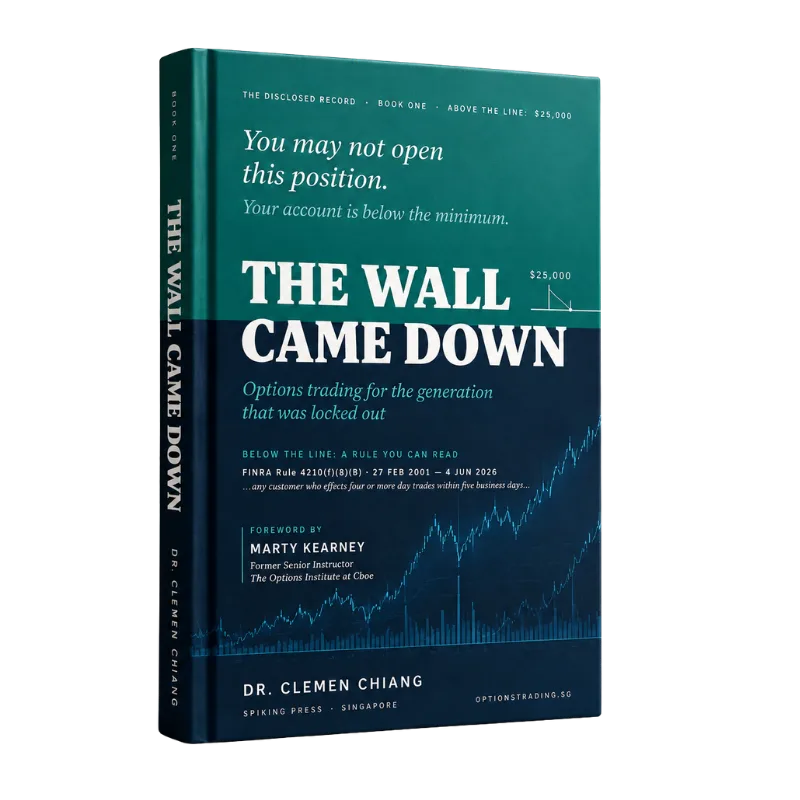
New book · Dr. Clemen Chiang
The Wall Came Down
Options Trading for the Generation That Was Locked Out
Every one of the 56 structures, written out with its payoff, breakeven and the conditions in which it fails, against one transparent option chain you can check yourself.
Hardcover · Paperback · Kindle · Audiobook · ISBN 978-981-94-7240-6
The masterclass is the 45-minute live introduction. The book is the reference you keep.
Straight answers
Long call FAQ
What is a long call option?
A long call is a call option you have bought. It gives you the right to buy 100 shares at the strike price until expiry. You pay a premium for that right, and the premium is the most you can lose.
How do you calculate the breakeven of a long call?
Add the premium to the strike price. A 105 call bought for 1.08 breaks even at 106.08 at expiry.
What is the maximum loss on a long call?
The premium paid. If the stock finishes at or below the strike at expiry, the call expires worthless. On one contract with a 1.08 premium that is $108, plus any commissions.
Is the profit on a long call unlimited?
In theory yes. Above the breakeven, each 1 point rise in the stock adds 1 point per share, and the stock price has no ceiling.
What happens if a long call expires in the money?
The call has intrinsic value equal to the stock price minus the strike. Most brokers exercise in-the-money options automatically at expiry, which would put you long 100 shares per contract. If you do not want the shares, sell the call before expiry. Check your broker's policy.
Should you exercise a long call or sell it?
Selling is usually better before expiry, because the contract still holds time value that exercising gives up. Exercise matters mainly when you want the shares.
How much does a long call cost?
The premium multiplied by 100 for a standard contract. A premium of 1.08 costs $108. The price depends on the strike, the time to expiry and implied volatility.
Why can a long call lose money when the stock goes up?
Three things can offset a rise: the stock may not pass the breakeven, time decay removes value on the way, and implied volatility can fall. The masterclass shows how to read all three.
That was strategy 1 of 56.
The free masterclass shows how the other 55 fit around it. In 45 minutes, Dr. Clemen Chiang goes from the contract itself to reading payoffs and building structures live. No experience needed.
- Tuesday, 12 January 2027
- 8:00–8:45 PM SGT
- Live with Dr. Clemen Chiang
Free to join. You sign up on the masterclass page.